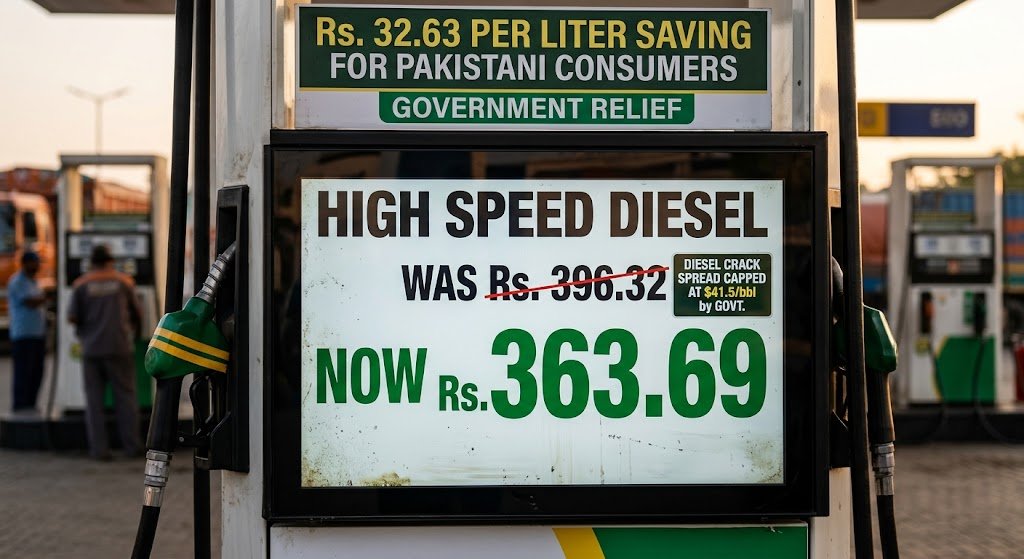
In a shocking yet welcome twist, Pakistani drivers are waking up to a massive Rs. 32.63 per liter cut in diesel prices. High-speed diesel now stands at Rs. 363.69. But this relief comes with a twist: petrol prices have quietly edged up, creating a stark contrast. How did this dramatic and unusual decoupling happen?
It wasn’t simple market forces. It was a targeted, calculated intervention. The government negotiated with the country’s main refineries to cap the ‘diesel crack spread’—the critical difference between the cost of imported crude and the final refined price of diesel—at a strategic $41.5 per barrel. Without this intervention, international soaring markets would have pushed the spread to $68 per barrel, making diesel prices astronomically higher.
This was no casual meeting. Virtual discussions, initiated on the prime minister’s directives, involved the Petroleum Minister, the Secretary, and senior refinery managers. The goal was simple: get the four major Karachi-based refineries to absorb some of the high international pressure instead of passing it all on to consumers. They agreed to the cap but are seeking a mechanism to recover the per-barrel premium they pay on imported crude.
The slight petrol increase (up Rs. 2.97 to Rs. 337.51) highlights that this was a targeted diesel-first strategy. The cap is a temporary firewall, set to last until global oil markets and the geopolitical tension in the Strait of Hormuz stabilize.
The dramatic price drop isn’t without risk. Downstream oil marketing companies and dealers are now facing potential losses, as they might have to sell inventory purchased at the previous, much higher prices at the new, capped rate.